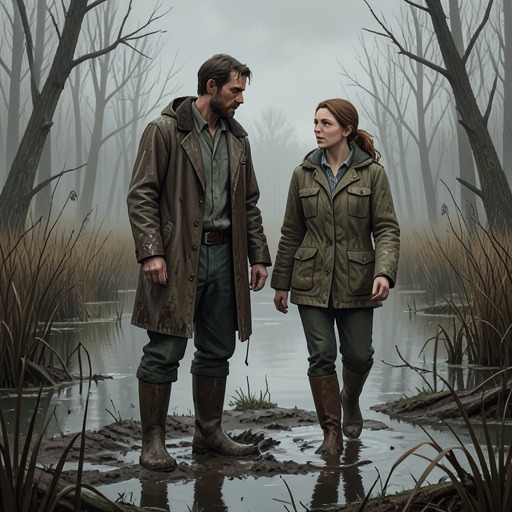
the swamp
Norwegian WoodThe swamp is Watanabe’s recurring image for a life moving forward without a clear destination: first the exhausting stagnation of 1969, then the grief that separates him from the living after Naoko’s death. Its significance lies in that change of scale. What begins as a metaphor for a year he can barely get through becomes part of the novel’s larger account of mourning, where continuing to walk is necessary but does not mean that sorrow has been overcome.
A Year in the Mud
Looking back on 1969, Watanabe remembers not a sequence of milestones but a swamp: deep, sticky ground that seems ready to pull off his shoe at every step. He is exhausted, sees darkness in every direction, and finds no firm vantage from which to understand where he is going. The metaphor turns the passage of a year into a bodily ordeal, measured not by achievement but by the repeated effort to move one foot after the other.
Time itself seems to slog at the pace of his faltering steps. Other people, he feels, have gone ahead, while he and his time remain behind in the mud. The contrast makes the swamp more than a private figure for low spirits: it expresses his sense of being out of step with a world on the brink of transformation. The period’s calls for revolutionary change promise a turn just ahead, but what arrives seems to him no more than a two-dimensional stage set, a backdrop without substance. Public language announces movement; his own days remain stuck.
That mismatch is sharpened by the ordinary pattern of his life. He turns twenty as autumn yields to winter, but nothing significant changes. He attends lectures without excitement, works three nights a week in a record shop, returns to The Great Gatsby from time to time, and spends Sundays doing laundry and writing a long letter to Naoko. Meals, trips to the zoo, or cinema visits with Midori interrupt the routine without dissolving its prevailing sense of inertia. The swamp’s force comes partly from this plainness: its darkness is not a dramatic wilderness elsewhere, but the dull continuity of days that must still be lived.
The Mud and the Need to Keep Moving
Watanabe describes himself trudging through each day with his eyes fixed on the mud ahead. The repeated sequence of planting one foot, lifting the other, and then reversing them strips progress down to its smallest physical measure. He does not know where he is or whether he is headed in the right direction; he knows only that he has to keep moving, one step at a time. The image offers no promise that perseverance will reveal a destination. Movement is a necessity before it is a solution.
When 1970 arrives, Watanabe calls it a year with a wholly new sound, but that freshness does not free him from the metaphor. He expects to step into a whole new swamp. The turn of the year marks an ending—his teenage years are over—while the old condition persists in altered form. Even the prospect of a new beginning carries its own bog: time advances, but he cannot simply leave behind the pattern of delay and uncertainty.
The metaphor also gathers meaning from the losses that precede and surround this period. Earlier, after beginning a new life in the dorm, Watanabe tries to stop taking everything so seriously and to establish distance between himself and the world. The effort seems to work at first, but a vague knot remains inside him. It eventually becomes the understanding that death is not the opposite of life but part of it: death is present in ordinary objects and in the lives of those still breathing. The swamp belongs to a life already burdened by that knowledge, not merely to a passing bad year.
From Dormitory Conflict to a New Address
The feeling of being bogged down has practical consequences as well as emotional ones. In February, Watanabe punches a third-year student in a foolish fight. The other student strikes his head against a concrete wall but is not badly injured; Nagasawa smooths the matter over. Watanabe is nevertheless summoned to the dorm Head’s office and warned, and he becomes increasingly uncomfortable living in the dormitory. The episode places his private unease inside a setting where small conflicts can leave him more alienated from the life he has been trying to manage.
The next academic year brings more sustained dormitory unrest. Members of a political faction keep helmets and iron pipes in their rooms; after a confrontation with baseball players supported by the dorm Head, two faction members are injured and six are expelled. Minor fights then break out almost daily, leaving the dorm oppressive and its residents on edge. When a baseball player nearly knocks Watanabe out, Nagasawa intervenes again. This time Watanabe decides he must leave. After searching for a week, he finds an independent house far out in Kichijoji: inconveniently located, but a real house and, to him, a fortunate discovery.
Three days after moving, he writes to Naoko about the house and his relief at escaping the dorm and its conflicts. He imagines that a new setting and a new frame of mind might begin a new life. But the metaphor does not vanish with his change of address. When he and Nagasawa part, Nagasawa goes to his new world while Watanabe returns to his swamp. The contrast makes the image resistant to any simple explanation: leaving the dorm removes one source of pressure, but does not itself carry Watanabe out of his inward difficulty.
Grief Becomes a Landscape
After Naoko’s death, Watanabe travels west, moving along the coast as far from Tokyo as he can get, perhaps in Tottori or on the hidden side of Hyogo. The outward journey has concrete, repeated routines: he finds places to sleep in the sand, makes fires from driftwood, roasts dried fish bought from local fishermen, drinks whisky, and listens to the waves while thinking of Naoko. Yet the distance he covers cannot make her death comprehensible. He has heard the nails driven into her coffin, but cannot adjust to the fact that she has returned to nothingness.
At night, memories return in an uncontrollable stream. He sees Naoko cleaning the aviary in a yellow raincape, the collapsed birthday cake and her tears soaking his shirt, her camel-hair coat on a winter walk, the hairslide she always wore, and her blue nightdress as she sat with her knees drawn up. These sharply particular memories make absence more vivid rather than less. Watanabe feels transported to a place where he can speak with Naoko and hold her; there, death is one of the elements of life rather than its decisive end. The imagined nearness briefly soothes him, but the tide eventually withdraws, leaving him alone on the beach as sadness closes in and tears come.
In the midst of that grief, the swamp’s image is no longer simply a figure for a year of stagnation. It has become part of a larger terrain through which Watanabe must continue after losing Naoko. He recalls learning from Kizuki’s death that death belongs to life, but recognizes that this knowledge cannot cure the sorrow of losing someone he loves. No truth, sincerity, strength, or kindness can remove it; the sadness must be lived through to its end, and whatever he learns will not spare him from the next loss. A young fisherman’s sympathy for the mother he lost at sixteen only intensifies Watanabe’s rage: to him, the story cannot meet the particular fact that Naoko is gone. The encounter shows the limit of general consolation, not a lack of compassion in the abstract.
Return Without Release
Returning to Tokyo does not end the journey through grief. Watanabe shuts himself in his room for days, still fixed on the dead rather than the living. The rooms he had set aside for Naoko remain shuttered, their furniture draped in white and their windowsills dusty; he spends much of each day there. He speaks inwardly to Kizuki, imagining that Naoko has returned to the one she chose, while admitting that he tried to build a new life for the two of them in the imperfect world of the living. Her death, he feels, has carried another part of him into the world of the dead.
The swamp therefore marks both delay and persistence. It does not promise that grief will resolve into a clean lesson, or that a changed year, a different house, or a long walk will restore Watanabe to an uncomplicated life. Its recurring steps hold together his stalled sense of time, his inability to catch up with public promises of transformation, and the bare obligation to go on living. The novel’s movement through mud and along the shore gives that obligation a shape: continuing is possible, but it does not undo loss or make the path clear.